Friday, 3 May 2013

Old photo investigation Part 2 -- The Hamiltons of Fintra

Above is the second of the two original photos I pulled out, almost at random, from the large box of old photos at the fleamarket in Brighton. At that point I hadn't even realised that it was connected to the first. If you haven't read the first instalment of what has become, for me, a very satisfying saga, catch up here.
This is the back of the photo and tells us that it was taken on June 2 1925 at Bitterne, Cleeve Hill, near Cheltenham. The people in the photo are Henry Fitzgerald Reynolds' elderly mother, Matilda, his sister Mabel and his wife Gladys (I confess I'm not 100% sure which of the other two women is which -- I think it's Mabel in front). I imagine Henry was behind the camera on a visit to his mother in what was perhaps her nursing home (she seems to be in a bath chair) or just a lovely quiet house that she had retired to. From the pebbledashed wall and the window panes that you can see, I think the house must have been this one or one like it, with a view over the valley below:
Or perhaps this is a photo of Henry's mother's house, among the pictures I found on my second trip to Brighton:
I love this funny, skewed photo, taken in September the previous year -- it looks about right in terms of the windows and walls, but I haven't been able to spot this house on my Google Street View visits to Cleeve Hill. There's no information on the back apart from the date.
     By finding the photo of Henry's mother I've been able to clear up uncertainty about the date of her death. Most of the people researching the Hamilton family (on Ancestry.co.uk and so on) have her death tentatively recorded as 1907 in her native Ireland, but in fact she died in 1930, aged 88, and her death was registered at Winchcombe, very close to Cleeve Hill.
Matilda Hamilton was born in 1842 at Fintra House near Killybegs, in Co. Donegal, Ireland. For a long time I thought that it was the white house on the far side of the bay in this old postcard, just above and to the left of the square tower of St Mary of the Visitation Catholic Church (the nearer church is St John's Church of Ireland Protestant Church). However, a kind commenter has put me right (May 2021): the white house is actually the Glebe House. Fintra House  is out of sight behind the hill beyond the Glebe House! Fintra was built in the late seventeenth century (I think) and  faces a bay: for a long time it was used by passing ships as a landmark, so clearly did it stand out.
The Hamiltons of Fintra House were a well-known branch of the Hamilton family who originally came over from Scotland during the 'Plantation of Ulster' to take over lands forcibly confiscated from the Irish families whose power base the English crown wanted to thoroughly undermine. I'm on very thin ice with my grasp of this history, so if you want to know more, try Wikipedia. Other researchers have done amazing work tracing the Hamiltons back to the time of James II of Scotland. In particular, I consulted a vast tome, published in 1933, called The House of Hamilton by Lieutenant-Colonel George Hamilton:
This is a bit of an aside, but the copy of the book that I was able to borrow from University of Birmingham Library had once been the personal copy of Thomas Erskine Swanzy and had his name and address inside in his own handwriting as well as his bookplate, based on his family coat of arms:
I know this is is T E Swanzy's own handwriting as I was able to compare it to his census form from the 1911 Census when he was Vicar of All Saints Church in Lincoln. Himself a descendant of a very old Irish family, Swanzy was a very keen genealogist who corresponded frequently with Henry Fitzgerald Reynolds on various obscure matters of Irish family history which they both then published in Irish history journals. In fact on the page about 'my' Hamiltons, Henry gets an acknowledgement in the footnotes:
Matilda Hamilton was the youngest of the ten children of James and Ann Hamilton. Ann's maiden name was Hutchinson and she came from Earby Hall near Newsham, which in turn is near Richmond, North Yorkshire, where I come from. I know it's only a tenuous link, but when I saw 'Richmond' popping up in my Ancestry.co.uk searches, I felt even more connected to this family.
     Ann, who was born in 1803, outlived her husband James by 32 years. He left the house to his wife, but after she died in 1881 under the terms of James's will the house and all the land the family owned was supposed to be shared out equally between the children. The will took a long time going through probate but in 1885 Matilda's sister Isabella and her husband Richard Gorringe bought everybody else out and moved into Fintra House. They had ambitious plans and tried to develop the house. They built the clock tower and coach house in 1896 but unfortunately ran into financial problems. In the photo below you can just see the clock tower and the other new buildings to the right of the original house:

The property passed into different hands eventually and, sadly, the house was burnt down in 1923 during the Troubles (although according to my kind Killybegs commenter, it was rebuilt before finally being demolished in the 1980s). Today only the Clock Tower remains and is run as a restaurant (below).

Nothing remains of the house itself. As there has been some discussion in the comments about the exact location of the house, here's a map, if helpful (added May 2021).


     On 18 May 1864 Matilda Hamilton married Walter Reynolds of Melton near Hull at Fintra House, which was still occupied by her widowed mother at that date:


'My' Henry was their first-born and they had six children in all. They lived at various addresses in and around Hull. Matilda's husband died in 1893 when she was only 51 and she lived for a further 37 years. In 1901 she was living 'on her own means' in Eastgate House, Cottingham on the outskirts of Hull with her son Walter, a stockbroker (Henry's younger and only brother) and her three surviving daughters (her daughter Kathleen had sadly died in childhood):
Only Henry had flown the nest. He must have gone down to London to get his education in order to become an engineer and analytical chemist. Just before he got married in the summer of 1911 he was renting rooms in this house at 92 Denbigh St, Pimlico:
Then he and Gladys (nee Williams, from Southampton) got married and went to live in Merton Hall Road, Wimbledon. He was 45 when he married, Gladys quite a bit younger at 29.

It would be brilliant if they had lived at no 95 Merton Hall Road, above, with the dragon on the roof, but I have no way of knowing. It must have been a similar house to this one, though.

We'll leave Henry and Gladys for now. In future instalments I'll be looking into Matilda's brother who went to South Africa and America, her nephew who emigrated from South Africa to Australia, and her cousins who settled in the Texas Panhandle, plus my favourite Hamilton, Nancy.

London glamour

To the London Palladium, my dears, yesterday morning, for a glamorous event, the Theatre Book Prize 2013. Our lovely author, Margaret Leask (above left, with prize judges Penelope Keith and Henry Hitchings, winner Ian Kelly and, in front, Timothy West), was shortlisted for her biography of Edwardian actress and proto-feminist Lena Ashwell.
We were thrilled to hear Penelope Keith call Margaret's book 'a real page-turner' in her presentation before the winner was announced. Sadly, it was not our book, but Ian Kelly's biography of Samuel Foote, a one-legged comic actor in Georgian London, that won. Many congratulations to him.
Margaret receives her certificate from Timothy West
Everywhere I go these days I'm dogged by Fenella Fielding!
There were lots of other wonderfully mature actors present, all ever so slightly 'on'. Even my mobile phone provoked straightenings of the spine and a proud lifting of the chin in several.
Afterwards I nipped along Oxford St to see the Deutsche Borse show at the Photographers Gallery. I found this very exciting and inspiring because, of the four shortlisted photographers, only one, Chris Killip, takes conventional photographs. While these were excellent (of places that I know from my North-East childhood), it was the other three who really gave me food for thought. Adam Broomberg and Oliver Chanarin had 'invaded' a book by Bertold Brecht from 1955, gluing their own found imagery (which was closely linked to the originals) over Brecht's photos to profoundly shift the impact of the text. It was a really interesting 'altered book'. Cristina de Middel mixed fact and fiction in a very funny and wry project on Zambia's ill-fated bid to join the space race in 1964.
     My favourite of the four shortlisted photographers was Mishka Henner who, like me, is obsessed with Google Street View and has used it to track down sad glimpses of prostitutes in Italy standing by lonely roadsides. It was amazing to see the phrase 'shot entirely with Google Street View' in the brochure accompanying the show -- almost suggesting that Street View is some sort of camera that allows viewers agency. It seems to legitimise the use of Street View shots (as did Jon Rafman's show at the Saatchi Gallery recently, The Nine Eyes of Google Street View, which I also enjoyed) and makes me feel much more confident about my own use of Street View.
But absolutely the BEST Street-View-based art I've seen recently is this video by Teehan & Lax Labs. Please watch it -- I just love it. This is my dream! To travel the world through the portal of Google Street View and this film seems to bring it closer to reality.

Back soon with more on my old-photograph family...

Wednesday, 1 May 2013

More old photos investigated

Here's another of the photos I dug out of the box in Snooper's Paradise in Brighton (Here's my earlier post on this if you're interested). This is the back of it:
What a wealth of information on the back of a small photo! The person who wrote it was evidently  extremely organised as they have numbered it as part of what I assume must be their entire collection -- and yet even that diligence has not been enough to stave off the forces of chaos, for it ended up in disarray in a flea market.
     It says:
No 358                    19th Sept 1931
At the Cairn on top of Brean Down
nr Weston Super Mare
___________________
Nancy Hamilton
Kathleen Gladys Fitzgerald Reynolds
Henry Fitzgerald Reynolds

One can only wonder at the sort of mind that writes full names out on the backs of their photographs.

Since I wrote the above, a couple of months have passed. I continued researching the people in the photo and got completely caught up in their family history. It turns out that Henry Fitzgerald Reynolds, the gentleman who appears in the photo and who also wrote all the information on the back was himself an extremely keen genealogist who carried out the most rigorous research into various families in Ireland (mostly linked to his wife's family, the Hamiltons) and, through the work that he published in the early twentieth century, has actually helped me to research his family all over again.

The people in this first photo are Henry, born 1865, his only child Kathleen, born 1912, and his great-niece from his wife's side of the family, Nancy Hamilton, born 1908. His wife Gladys must have been behind the camera, I think. She was born in 1882.
I've done a lot of research into Nancy, although I haven't really been able to find out very much about her (in terms of solid facts). I thought I had found an autobiographical memoir that she'd written (I was so excited when I thought I'd come across that) and I arranged to borrow it from the National Library of Australia. I thought it would fill in all the missing details of Nancy's life but, sadly, when it came, it was by a different Nancy Hamilton with no connection to 'my' one. I'm going to save Nancy's 'story' for a subsequent post.
My earliest photo of Henry and his daughter Kathleen, perhaps from about 1922 -- this one isn't dated . Evidently a holiday snap taken from some mountain lookout. Probably taken by Henry's wife Gladys
 I do feel as though I've started to 'own' the Hamilton and Reynolds families, purely as a result of focusing so intently on them, but in fact there are lots of people researching them, many of whom actually have family links to them. My only links are through these few photos I now own (22 in all -- I went back to Brighton and found more, as you may recall).
The marker on top of the cliff at Brean Down, nr Weston-super-Mare
I've now followed up so many different branches of the family that I scarcely know where to begin to write it all down. There are stories of pioneering in America, of diamond-hunting in South Africa, of crime (though not committed by an actual member of the family but one of their employees), of illegitimacy, celebrity and betrayal. This family is so much more compelling than my own! All this to come in future posts, but for now let's start with that first photo taken at Brean Down near Weston-super-Mare, which you can see above as it is today.
     When the photo was taken, in 1931, Henry and Gladys were living in Cardiff at 59 Westville Road (of which more in a moment). But they seem to have taken their holiday in Weston-super-Mare that year. Here's another photo of them from a couple of weeks earlier, with their friend Peggy (Margaret) Freeth:
Henry's wife Gladys is in front, daughter Kathleen at the back.
There's another photo of the three women, taken on the same day. They're taking the ferry across the River Axe at Uphill, which is on the way to Brean Down from Weston-super-Mare, so it was probably taken earlier in the day (or conversely on the way home):

I love the way Fred Patch the boatman is the main subject of the photo (who knows whether this was by design, perhaps not). Even though the image is out of focus I love it.
The next day, the holidaymakers went to Cheddar Gorge. Here are Henry and Gladys standing in front of the waterfall there. Perhaps they asked Peggy to take the photo for them:
This is what it looks like today:
Top waterfall, Cheddar Gorge copyright Eugene Birchall
Henry was an engineer and analytical chemist. Beyond that, I don't know very much about his career. I'll go back through his family history in a later post, but for now, this is the house at 59 Westville Road, Cardiff, where he and Gladys were living in 1931:
 Here are Henry and Gladys looking rather happy, on what is probably the back doorstep:
Here's another of Henry's photos taken there, in the back garden:
I'm afraid I haven't been able to identify the lady. It isn't Henry's mother or mother-in-law. I can't decipher the name on the back of the photo -- can you?

Henry and Gladys must have been very fond of Weston-super-Mare because they moved there a few years later, to 4 Malvern Road. This is the house today, another lovely, solid late-Victorian house:
This is Henry's photo of the rear garden there:
I really should stop for now, although I've hardly scratched the surface. To finish, a photo of Henry's daughter Kathleen in 1938 when she would have been 26. She is in the garden of a house called Park View in Minchinhampton. I like to think that she had perhaps got married, or at least was living happily there.I don't know anything further about Kathleen except that in later life she lived in Barnet, Hertfordshire and supported wildlife causes. She looks like a jolly good sort, don't you think?
Here are her parents, who were visiting her, looking very relaxed in Kathleen's garden in Minchinhampton, although Henry is, as ever, in his Edwardian 'uniform' of three-piece suit and stiff collar and tie:
Come back soon for lots more about this family's forebears...

Tuesday, 16 April 2013

A book lover suffers

Just a quick report from the London Book Fair today. I go every year and every year I feel more alienated, more sad at the hellish vision of the book industry. I absolutely love books, they're my oxygen, but I don't love the spectacle of the book business, the countless recycled ideas, the sheer excess of books being churned out in the hope of keeping too many businesses afloat. Having said all that (which I haven't thought about carefully enough, I suspect -- just splurging after a long tiring day), the freedom to publish another six thousand cookbooks is the same freedom that we (happily) extend to pretty much anyone who wants to write a book in this country, so I wouldn't have it any other way, however dispiriting it may be to see the massed ranks of erotica and poorly illustrated children's books on the stands at Earls Court.
It was hard to take photos as people are mostly in meetings on their stands and it's business as usual. However, there are side events which are more public. Above is the extraordinary sight of the actress Fenella Fielding, who is 86 and in some strange state of preservation which makes her resemble one of those very expensive Japanese surrogate humans made of silicon. I assure you she smiled and spoke, in spite of appearances to the contrary. She was giving an inaudible talk about correct pronunciation of English. Surreal.
Turkey was the 'special guest' at the Fair this year and there were lots of Turkish publishers with stands. Above is the Turkish author Elif Shafak who was very beautiful.
Some books, like this one, were unbelievably expensive. Some not so pricey. I picked up the catalogue of Shire Books who publish the marvellous short guides to thousands of lovely old things, from Airfix kits to Wrought Iron, all priced between £4.99 and £6.99. I would like to own almost every single one of them -- their lovely illustrations and businesslike texts usually match the depth of my interest in, say, village shops or shell grottoes perfectly. I can't believe how many volumes they've racked up now -- and all with great covers. I covet them. I was particularly taken with this one, below.
And now to sleep.

Sunday, 14 April 2013

A day trip to Brighton

This was the (slightly 'Shopped) view at my feet as I waited for the 9.20am train from Luton yesterday morning. I had had to give in to an insistent voice in my head telling me to go back to Brighton again. Brighton looms nearer because there's a wonderful direct train from Luton that takes you there in two hours, right through the heart of London. Unfortunately, I only discovered after I'd bought my ticket that the 'through' part wasn't working this weekend so I had to cross London by Tube. Still, by noon I was in the North Laine (and the rain). 
It didn't matter. I wasn't there to sit on the beach (unlike this lovely pair, found yesterday). I was there to feed a terrible hunger that's been raging in me for getting on for two months now. You may remember that, last half term, I went to Brighton with my family and got to indulge my love of old photos with an hour in Snoopers' Paradise. I think I bought five photos that time. One was of Lionel and Ethel Long and I managed to find out a little about the Longs, as reported in this post. Two of the other photos I bought that day turned out to be related to each other. I started to research the family in them and it exploded into an almost full-time project. I haven't been so absorbed by something for a very long time. I'm not quite ready to tell of my discoveries -- I'm waiting for a book to come from the National Library of Australia! Luckily I can arrange international loans through the Uni where I work. The book is going to be the culmination of the whole thing (I hope) but meanwhile I thought I remembered that there had been other photos from the same set that I'd left behind in Snoopers' Paradise.
    
There had been about 2000 photos in three or four boxes at the stall where I got the first ones and I had only had an hour. Now that I had got so intensely engaged with the family in the photos, I just couldn't bear the thought that there were more photos of them left behind. I had to go and see if I could get them.
     I went straight to Snoopers' Paradise and made for the stall where I remembered standing to look through the boxes of pictures. Nothing. There were no photos at all! I can't describe how desolate I felt. I thought some of them might have gone, but surely not all of them. I hunted all over the stall, in drawers, behind old fire screens, in cash boxes. Gone. Then I rallied myself and thought I should at least check around the rest of the flea market -- perhaps people own more than one stall and move their stock around. At the very least there would be other stalls with photos, even if they weren't my special ones. I couldn't leave empty handed. So I spent an hour or so going round the whole place. I didn't find 'my' photos but I found a few other nice ones, including the beach scene at the top. I went to pay and to interrogate the people on the till. 'Can I contact one of the stallholders, please? I came specially to get some photos and I can't believe they've all been sold.' They rolled their eyes and said, 'No.' The woman said, 'There are lots of other stalls with old photos, I'm sure you'll find something you like.' I couldn't explain how I felt that my 'photo family' needed to be kept together and that those photos were saturated with meaning now. They'd come to life.
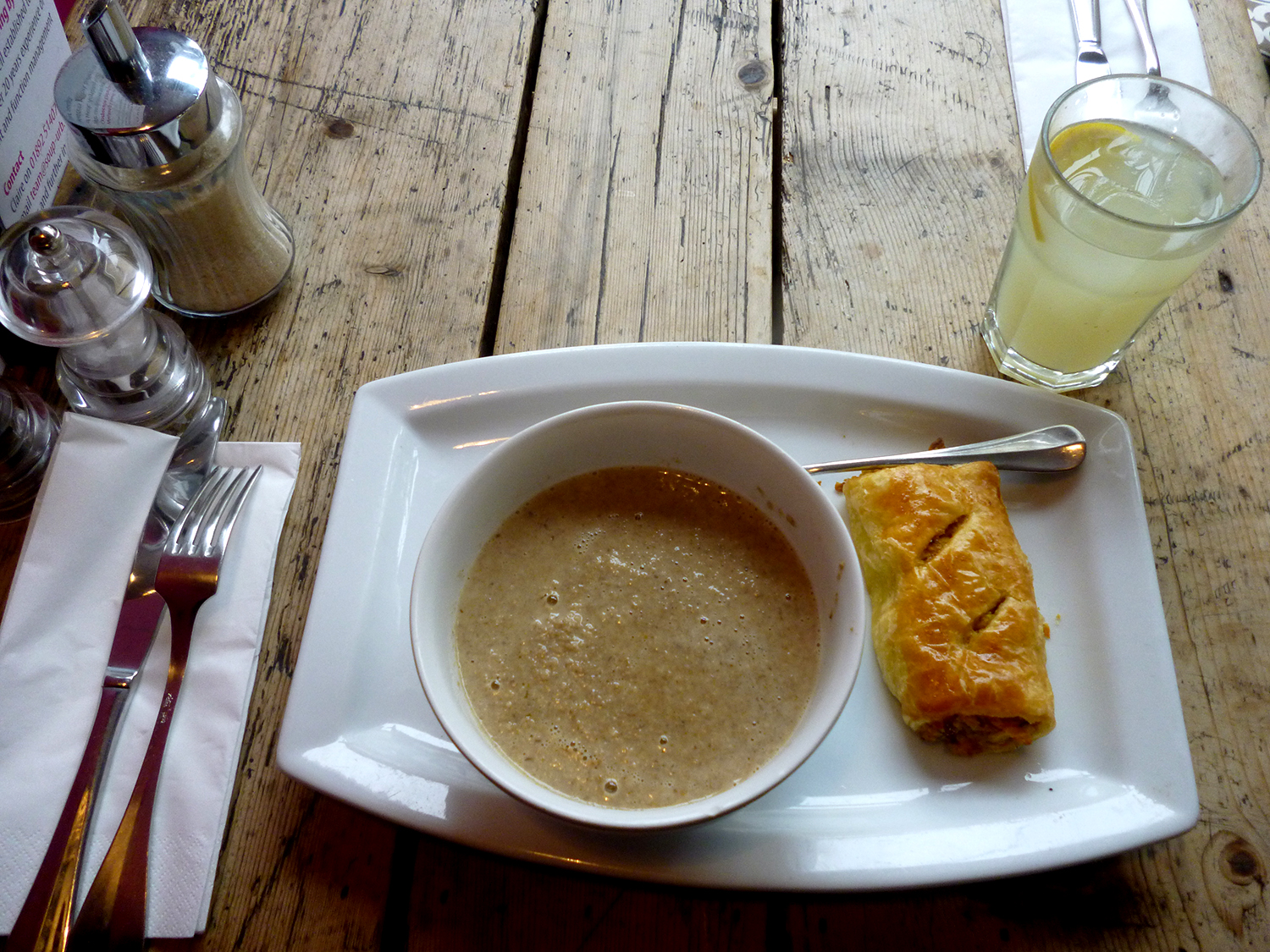
I went back out into the rain and got some lunch -- the £6 special at Soup-Urb -- pretty nice. The piece of rocky road I had for pudding was the best I've ever had. I sat looking out of the window at the rain and I thought, 'I can't just go home. I'll go back to Snoopers' Paradise and I'll look round with my "kitsch" eyes on instead of my "old photos" eyes. There must be something cool in there.'
     Back I went. It was more like a fun house in there than a flea market -- everyone was trying on wigs and hats and taking photos of each other: 'Try this coat on, you'll look just like a pimp!' I wandered round and within a couple of minutes, I have no idea how, I'd found the stall with the boxes of photos! There they were, still thousands and thousands of them, all jumbled up. What with misremembering which stall it was and then missing it on my first trawl, it's a miracle I found it at all. I was so happy. I hunkered down on the floor and went through each box systematically to sort out the ones I needed. Very thoughtfully, 'my' chap had numbered and dated all his photos so it was easy to tell which ones were his. And I know his handwriting so well now -- I've matched it to his 1911 census return. If anyone had been watching me (I'm sure no one was remotely interested) they'd have seen me going through box after box of photos looking only at the backs. I found TWENTY more of 'my' photos. Some of them are very blurry or don't have any people in them, but I bought them just the same. I had to reunite them as much as possible. What's hard to bear is that the highest number on the ones I've now got is 'No. 442' and I only own 22 in total, so I don't like to think about where the other 420 have got to. I wonder if I'll ever find any more of them? Probably not.
     I was in Snoopers' Paradise until almost 5pm, just sorting through photos. By the time I left I was so stiff I was reeling. I just went back to the station and caught the next train to London. It was the strangest day out I've ever had but I have assuaged the need I had to see what was still to be found.
I'm keeping schtum for now on the story I've managed to find out, but will just show one of the photos I got yesterday, of the daughter of the family -- blurry but lovely, I think. More -- much much more -- to come...


Sunday, 7 April 2013

Asking awkward questions

So sorry for the intermittent blogging of late. Lots going on including a mini car crash (a literal not metaphorical one) which took up far too much time to sort out, but you don't want to hear about that (I've just deleted a whiny paragraphy about it...) -- no one was hurt and it wasn't my fault, and it's sorted now.
     More interesting (hopefully) was a great day out in London with my son. As I was wearing my pedometer (part of a project at work to motivate staff to be healthier), I know I walked 14,500 steps, all told. Not bad, seeing as we took the tube everywhere, so the walking must have been mostly inside the three galleries we managed to fit in.
First up was the Roy Lichtenstein retrospective at Tate Modern. I had more or less decided to give this a miss, but my son wanted to see it. I'm glad we went as it was worth it to see Lichtenstein's works at their real size: reproduced in books and magazines, they shrink back down to the scale of the images they are based on and thus lose one important aspect of their 'difference' from those originals. It was great to be able to examine the canvases up close and to see the tiny blobs and flaws that are another of the signifiers of the artist's hand at work (rather than a printing press). I particularly liked the black-and-white scaled-up images of objects from adverts (a glass of Alka Seltzer, a ring, a tyre, a radio...). However, I found myself thinking heretical thoughts.
     Firstly, was there no issue with copyright when Lichtenstein lifted the work of comic book and other graphic artists and made derivative works from it? As far as I've been able to find out, none of the artists whose work was 'borrowed' ever sued Lichtenstein. I think the early Sixties must have been a more innocent era when thoughts of copyright infringement perhaps simply didn't occur to people. Since visiting the exhibition, I've looked into this issue online and found David Barsalou's website dedicated to tracking down the originals on which Lichtenstein's works are based and also this article from the Chicago Herald Tribune. Do click on the links (specially the Barsalou -- it's fascinating). I'm afraid my feeling is that the originals are often better than Lichtenstein's versions: they're almost bound to be, because they were drawn freely, from imagination, unfettered by the constraint of having to copy someone else's drawing, which I know from experience can cause the hand to stiffen and become over-controlled. The originals are more alive, somehow, although I realise that's not really the point of Lichtenstein's work, which was precisely to elevate 'cheap' art to the level of 'high' art. In the exhibition, the funny thing was that whenever Lichtenstein dared to wield a paintbrush freely the marks he made seemed so weak and hesitant, completely different from his incredibly confident reproduction-work. Try this one, for example: Washington Crossing the Delaware. Actually, that's not the best example because it's so far removed from RL's signature style. It was the paintings where a stray bit of 'free' painting straggled across a more graphic background that I found more unsettling, and that may very well be the whole point -- to disturb and alienate us.
Next it was Tate Britain (but, sadly, we didn't take the spotty river boat to get there) and Kurt Schwitters. It was fascinating to find out that so many German and Austrian emigres had been interned in Douglas on the Isle of Man, including Schwitters who was there for sixteen months. It was ironic, really, (and wrong, I think) that he was denied his freedom in Britain as he had fled Germany in 1937 after the Nazis included his art in their sneering exhibitions of 'degenerate art'. He went first to Norway but the Nazis invaded there, so he fled to Scotland on an icebreaker. The internment camp in Douglas contained many artists and academics and there seems to have been a rather lively atmosphere, with lectures, a camp newspaper and art made with whatever could be put to use: Schwitters made sculptures out of porridge which went mouldy. They ripped the lino off the floors to make lino cuts and scratched drawings into the windows. More on the Schwitters page on Wikipedia. My son found Kurt's endless rather repetitive collages a bit dull and dated. I thought it was a shame they chose the most colourful and cheery one by far for the tantalising poster -- the overall impression in the exhibition was of  brownness (this sounds as though I didn't like them either, but I did -- they quietly told his life story in train tickets and chocolate wrappers). I enjoyed hearing Schwitters performing his Dadaist sound poem, Ursonate ("beeeee bö fümms bö wö tää...") -- see (and hear!) here. One of the most extraordinary elements of the exhibition was a room that had been created by Laure Prouvost, in response to Schwitters' installation in the Lake District, Merzbarn ('merz' was his made-up word for the raw materials of his collages and montages). Prouvost created a surreal tea room with misshapen cups and teapots, and chairs customized with Schwitters-style agglomerations of wood. A film she had made was showing -- she narrated the story of her imaginary grandfather who, we were told, had been a great friend of Kurt's and had received many of his artworks which he had put to more practical use -- as a draining board or a candlestick. It was very mad and funny.
For our lunch we made a pilgrimage to Benito's Hat on Goodge St, a Mexican place my son discovered when he did a week's work experience nearby. I took a photo of our EPIC burritos but they just looked like doughy canisters, completely belying the deliciousness within -- who would have thought so much could be packed inside a tortilla? Amazingly good value too.
Finally to the Royal Academy to see the George Bellows exhibition. Bellows is not such a well-known artist (not here, anyway) and he's interesting because he seems to bridge the schism between late nineteenth century figurative art and modernism. He died terribly young, in 1925, aged only 37. His paintings of the Lower East Side of New York and, particularly, his visceral scenes at boxing matches show both fantastic draughtsmanship and a feeling for alienated and excluded people in an urban context that reaches towards Edward Hopper (born in the same year but lived 30 years longer).


Sunday, 10 March 2013

Doing Something Different -- childhood treasures

This is just a quickie. I'm doing a project at work -- lots of us have signed up to 'Do Something Different', the behaviour change programme pioneered by Ben Fletcher and Karen Pine at the University of Hertfordshire. Every couple of days we are sent a new 'Do' which is a little challenge designed to shift us out of our comfort zones and promote bigger changes in behaviour (such as losing weight or giving up smoking, whatever your goal is).
The current 'Do' is to 'Do things you used to enjoy. Jumping in puddles, puzzles or playing games. Rediscover childish fun or an old hobby.' This is too easy for me, really, because I've never grown up, so spend quite a lot of time doing puzzles and indulging in childish fun. But to try to get into the spirit of the Do, I tried to think of something that I used to do but no longer indulge in so much (though I've just remembered a blogpost on this very subject not so long ago...). I remember how I used to LOVE arranging my 'treasures'. These were sad little bits of detritus that I had collected here and there. Above is today's arrangement of the bits and pieces I've picked up off the ground over the last month or so. Most precious are the passport photos -- a bit creepy, you may think, but I love finding discarded photos. I also like the coloured wire, magpied from telephony works at the Uni, and I also like the unidentified black rubbery thing at the bottom (the right hand one, not the left hand one -- though that's quite good too).
I am happy now.