Saturday, 7 September 2013

Looking for Mrs Jamfrey (and others)

A wonderfully terrible photo
Here are some of the random old photos I picked up at the weekend. Whilst I was crouched in front of the photos for all those hours on Saturday, I overheard quite a few people commenting on the phenomenon of the old, orphaned photographs and finding them weird; some of them expressed distaste: 'Ugh, photos of dead people!' I just can't understand that sentiment. They fill me with tenderness. They are not simply pictures of random people but records of actual moments in their lives. Who knows what fun was being had in the photo above, who loved who, who was excited at the opportunity to josh so physically? I will never know, but the photo is precious, now that I've picked it out of the sea of countless other untethered images bobbing round the world.
     Here are a few more:
Giant cat alert!

I picked out this one because it looked so perfect for a book cover:
I can just see it in my mind's eye:
Of course it's not me in the photo, but it's only an imaginary book...
 As I mentioned in my last post, I love finding old photos of houses and looking them up online to see what their history is and what they look like nowadays. On the back of the one above is written, 'Hillcrest, Augustine Road, Drayton'. Drayton, a suburb of Portsmouth, has changed enormously since this was taken (in the 1930s?) but I think I've found the house as it is today, though it has been painted and altered:
If you look closely, you can see the texture of the original brickwork beneath the paint. Funny that the chimneypots have disappeared -- redundant, I guess.
As you can see, the photo above is of 42 Pickhurst Rise. That turns out to be in West Wickham near Bromley in Kent. Today it looks like this:
Hardly changed at all.
I've been trying exhaustively to find this house:
The name 'Fir Cottage' is over the door and on the back it says, 'George's Mum's home near Guildford, Surrey, October 1951'. I've narrowed the search down to Shalford in Surrey but, despite hunting through census returns and all sorts, haven't been able to pinpoint the house itself. I shouldn't have spent so much time on it -- what difference does it make whether I know where this particular house is or not? None. But the search itself is incredibly absorbing and I love to link the past to the present.

This is Mrs Jamfrey from Northern Ireland.

I tell you what, I'd love a job as an 'heir hunter' -- I think I'm honing the very skills you need. It probably isn't as exciting as I think -- even on the telly they can't make it look terribly glam.

Friday, 6 September 2013

Serendipity? I'll show you serendipity

Dr Aleks Krotoski with her Serendipity Engine
Yesterday I turned Radio 4 on at my favourite time of day, for the 9.00 to 9.30am slot. Apart from Wednesdays (sorry, Libby), I almost always enjoy the programmes in this slot. And yesterday was Thursday, so the slot of the hallowed In Our Time, my favourite of all. However, Sir Melvyn is still bestriding the fells or walking through Green Park or whatever he does when he's off air and the programme I heard was Last Bus to Serendip, made by Dr Aleks Krotoski about her 'Serendipity Engine'.
     I love serendipity and I agree with one of the speakers in the programme, Phil Smith, who described the feeling when something serendipitous happens to you as 'a beautiful plane of ecstasy'. But as the programme unfolded I began to question it more and more. Dr Aleks, who is a clever and accomplished person and who has written lots of things I'd like to read, has made a machine which lives in suitcases and which tries to 'predict serendipity'. This very idea seems either self-contradictory (if something can be predicted then surely it isn't serendipitous, by definition?) or, less interestingly, just a bit of fun: a fancy name for a random generator of crazy combinations of things. I imagine it must tend more towards the latter, but the more I listened to the programme and then looked into the Engine online, the more irritated I felt that it was possibly being presented in a way that was, yes, quirkily 'fun' but also perhaps a bit bogus. The machine itself was described as very Heath-Robinson, fitting into a couple of suitcases and consisting of knobs and levers and flashing lights, but in fact -- and obviously it has to be, if you think about it -- it's an online thing. People who 'consult' the machine have to do various things including answering some silly questions such as 'What three foods would you eat if you were going to die tomorrow?' and turning a squiggle into a drawing. I'll come back to this in a moment...
     The programme itself irked me somewhat by pretending to be full of serendipitous meetings which were clearly arranged beforehand so that specific people could talk to Aleks about their take on serendipity. I know that's how it must be in order to put together a reasonable programme, but in a programme about serendipity it stuck in my throat that there was this pretence. Obviously Narguess Farzad didn't just happen to be sitting in a park reciting Persian poetry by Hafez when Aleks K happened along and they got talking about how Hafez is consulted as a type of divination. Equally obviously I guess Aleks didn't just jump on a train to Exeter and happen to bump into 'mythogeographer' Phil Smith who then spoke so eloquently about serendipity -- but it was the fact that she pretended to jump on the first train leaving from the station and it happened to be going to Exeter that got my goat. I suppose I should have suspended my disbelief and just enjoyed the programme. I noted that Prof. Richard Wiseman didn't seem to have played along with the serendipitous meeting thing and he was just on the end of a phone -- he's my kind of sceptic.
     Anyhoo, it got to the point where I thought, huh, maybe she didn't even go to Exeter, but Phil Smith had said that Aleks was sitting close to the bottom of General Sir Redvers Buller's horse, and, thanks to Google Street View, I found the very bus stop where Aleks is pictured on the BBC website (and above):
It is indeed just near the statue of General Buller on his horse, in the centre of Exeter. And if this isn't serendipitous, from one angle on Street View his horse has a traffic cone on its ear, making it look like a mad unicorn:
That made me quite happy.
    Anyway, I decided to have a go at the old Serendipity Engine myself. First of all you had to draw a circle inside a square (on a sheet that you printed out), and then you had to make a drawing from a squiggle. This is mine:
But then you had to let the Engine take a photo of you holding your sheet using the webcam embedded in your computer and the one I was on didn't have one -- so the pic was never uploaded. I answered all the other questions, including giving my address (postcode and house number), my Facebook, Twitter and Google Plus monikers, and I pressed the button to get the Engine's recipe for my special serendipitous 'koan' and the circumstances for considering it. This is what I got:
Well, isn't it just a lot of nonsense? The big giveaway is that apparently the Engine's Human Task Force had looked at my webphoto and my drawings to determine my level of personal attractiveness. I saw on the Engine site that it says real people are paid $1.50 a time to evaluate both your photo and your drawings. The creativity evaluation allegedly uses the Barron-Welsh Art Scale (which looks a teensy bit loopy). But my pictures were never even put into the algorithm because I didn't have a webcam. In lots of ways, I feel I should treat the Serendipity Engine in exactly the same way as I should have listened to the programme -- as something lighthearted and amusing, a bit of imaginative technology. But then I got rather paranoid and wondered whether there was conceivably some motive beyond fun for the Engine -- perhaps it's an experiment in how gullible people are, how readily they will give up significant and identifying data about themselves. Happily, there's a note on the Engine website that says if you want to remove your answers from the engine you can, by emailing Aleks Krotoski -- so I did, and almost immediately received a nice email back from her saying that my data was now gone from the dread engine. So all's well that ends well, and actually I'm sure the whole thing is far from evil -- it seems very transparent and there's a mass of information there to be read by anyone who's interested. Go on and have a look yourself, see what you think.
     The end of the story is that, later on, I actually reached that 'plane of ecstasy' of true serendipity when I discovered that one of the random photos I bought in Brighton (it's not one of Henry's pictures -- different writing, no number, etc) on Sunday actually has an extraordinary link to my obsessive interest in the Hamiltons of Fintra. I chose a few pictures of houses, if they were identified on the back, because I love looking up old houses on Street View to see how they look now. Among three or four that I bought was this one:
On the back is written: 'Dalton Fields Farm 14/7/40', so evidently taken in July 1940. When I googled it, I discovered that not only is the house less than ten miles from where I grew up in the Yorkshire Dales, but it was once occupied by a Joseph Glover, born in 1776. He married Elizabeth Hutchinson, from nearby Earby Hall, and she was the aunt of Ann Hutchinson, born 1803, who married James Hamilton of Fintra and was Henry Fitzgerald Reynolds' grandmother!
This is the house today. What really intrigues me is who the ghostly figures captured behind the railings of the 1940 photo are and whether they could possibly be relatives of Joseph Glover and Elizabeth Hutchinson? Three elderly ladies seem to be greeting a young boy. Is he carrying a suitcase? Was the photo perhaps taken as his parents dropped him off to stay with his granny and aunts for a holiday?
This photo has already given me an immense amount of pleasure -- serendipitously.

Next post: more old photo sleuthing...

PS: I have read Sartre and I don't think he's overrated.

Wednesday, 4 September 2013

Back to Brighton in search of Henry's photos

Brighton c.1950
Call me crazy (I usually do), but I've been back to Brighton again in an effort to gain 'closure' with regard to the cache of photos that I knew was there. I'd been brooding about those photos since I got the briefest of sessions with them back in June when I went to Brighton with my son for a Sussex University open day. On that occasion he dragged me away after about twenty minutes, but as I had already found a couple of photos belonging to 'my' Henry Fitzgerald-Reynolds, I couldn't get the idea out of my head that there might still be a few more left to find.
The latest (in the sequence) of Henry's photos that I now own: his vegetable patch, from 1943, two years before he died
I got an early train on Saturday morning and by half past ten I was back at the flea-market stall, sitting on a little stool in front of the boxes of photos.
I went systematically through every photo, first looking at the backs and then at the fronts. Anyone who saw me sifting through the backs of hundreds of photographs probably thought I really was crazy, but the backs of Henry's photos are the best way to recognise them as he was very organised and numbered almost all his pictures as well as annotating many of them. Thus the one above of the vegetable garden is no.524 and looks like this on the back:
So I know it was taken in 1943 when Henry was 77. 18 Hazeldene Road, Weston-super-Mare was the last house he and his wife Gladys lived in together (Gladys lived until 1971 but seems to have spent her final years in London). You can see that this is the slightly shaky handwriting of an elderly man -- he was 17 years older than his wife. Even though it isn't a very successful photograph, Henry obviously thought it was worth keeping, showing, as it does, the 'back of house, closer up, Raspberry canes on right'.
The house in Hazeldene Road today
All in all, I found thirteen more of Henry's photos during my trawl, including three without any annotation on the backs but where I recognised his daughter Kathleen, whose face I now know so well. Thirteen new photos was definitely worth the trip, and now I feel I need to really scrutinise them to see what new information might be gleaned from them. I wonder if I'll ever know who these people are, standing with Kathleen?:
Kathleen is on the right
And I wonder if I'll ever know what this building is or where it is?
No clue on the back of the photo as to where this is. The entrance is very imposing
Altogether, I now have forty of Henry's photos -- but what disturbs me is the thought of where the other 500 or so photos from his collection are (if I have one numbered 524)? They're out there somewhere, but I doubt I'll ever find them. I've scanned them all in order so that I can see Henry, Gladys and Kathleen growing older as the years pass by. Henry seems hardly to have changed over the twenty or so years that the images span:
Henry with daughter Kathleen as a child -- date approx. 1920
Henry with Gladys in 1938

I spent four and a half hours on my little stool at the photo stall! While I was there I heard all the browsers around me commenting on what was for sale and I can tell you that if you have an antiques shop or stall, the item that will arouse the most interest is a drinks cabinet in shape of a globe! Whether it would ever sell is another question. And while I was crouching over the photos, only one person spoke to me, a very nice woman (hello Jean, if you read this!) who asked me why I was sorting through the photos so carefully and with whom I had a really good chat.
     My best find on Saturday was a new picture of my favourite of Henry's relatives, Nancy Hamilton from Tasmania.
Kathleen, Nancy Hamilton and Kathleen's mother Gladys
As well as panning for the 'gold' of Henry's photos, I also picked out some other random photos that I'll blog about in my next post. And I went to Brighton City Art Gallery as there's always something interesting on there. This time there was a Jeff Koons Artist's Room. I'm always interested to see what Koons does, and I have enjoyed some of his more in-your-face art jokes in the past. I loved his colouring-book inspired piece outside the Royal Academy last year. But his meticulous reproductions in bronze of plastic inflatables leave me a little bit cold, though, and that was the centrepiece of this small show.
Also at the city art gallery was a beautiful selection of works from their collection by women.
I specially liked Averil and Veronica Burleigh. Veronica was Averil's daughter and both painted in the first half of the twentieth century. Averil's Washerwomen from 1930 is lovely (the washerwomen were probably modelled by Veronica and other members of the family, apparently), but I adore Veronica's 1937 painting, Self-portrait with the Artist's Parents. Veronica looks so strong and newfangled in those sunglasses.
Washerwomen by Averil Burleigh, 1930
Veronica Burleigh: Self-portrait with the Artist's Parents, 1937
She definitely seems to be saying that she belongs to a new generation of artists.


Thursday, 29 August 2013

Summer catch-up

Bum by Pauline Boty, 1966
 Bum, indeed, the summer is nearly over and even though I have been at work, as normal, through most of it, I've still got that deep-rooted 'back to school' feeling. It's intensified, of course, by my kids actually having to go back to school and there have been new blazers and bags and shoes to buy. Going back to school feeling spruced up and in some sense renewed is important, I think.
Pauline Boty, 1938-1966
I haven't been blogging over the summer, which I very much regret, but my Photoshop expired and without Photoshop I was stymied: no piccies, no blog. Now I've got Photoshop again and all is well. So here's a quick catch-up of what I've done of late.
     Way back at the end of July we made a pilgrimage to Wolverhampton to see the Pauline Boty exhibition at Wolverhampton Art Gallery. It's still on, until 16 November 2013, and is really worth a visit. There are very few female Pop artists, largely because of the sexist state of affairs in art schools and on the art scene generally in the 50s and 60s. Pauline Boty went to Wimbledon College of Art and then went on to the Royal College of Art to specialise in stained glass. She was there from 1958-61 and got to know Peter Blake and David Hockney, among other artists. The interplay of influence is particularly strong with Peter Blake. She was beautiful and iconoclastic and probably would have had a career as an actress or television star if she hadn't died of cancer at the age of 28. She refused treatment as she was pregnant and didn't want to harm her child. I love her paintings which are so sexy and joyful, full of portraits of her idols -- Monroe, Jean-Paul Belmondo, Elvis -- through which she seems to connect herself to them. Bum, above, was her last painting, commissioned as part of the stage set for Oh Calcutta!. More on her here.
     Wolverhampton Art Gallery was a great place with an excellent contemporary collection including a fantastic set of paintings of America by Lisa Milroy. There was also a really good touring show of Ron Mueck sculptures which is also on until the beginning of November (last day Nov 2nd).
Jonathan Slinger as Hamlet in the RSC's current production
While we were up in the West Midlands we took the opportunity to see Hamlet at the RSC in Stratford, with Jonathan Slinger as Hamlet. It was riveting. I last had anything to do with Hamlet when I did it for O level decades ago, but apart from the incredibly famous lines that crop up all the time, the whole play seemed lodged in my memory, so my teacher must have done a good job at the time. I enjoyed it very much. When we got back from the theatre to our hotel nearby there was trouble. We'd got ourselves two interconnecting rooms (for four of us) and on the way out my hubby had been extra vigilant and put the chain on the inside of one of the doors before exiting through the other one. Unfortunately, when we came back we opened one of the interconnecting doors to go back through to the other room and it caused a vacuum effect which sucked the corresponding door in the other room shut. There's only a handle on the room side of each of these facing doors, so there was now no way to enter the second room. D had to go down and confess what had happened and a chap came up to help. His only idea was to try to shoulder the interconnecting door open but he couldn't budge it. Then a supervising woman arrived, rather cross, and she managed (quite easily) to hook the chain off the door from the outside (which doesn't say a whole lot for their usefulness as a security device) and we got back in. We heard her outside the door saying, 'Why couldn't you have done that, Nathan?' and then huffing about 'stupid kids', whereas in fact they were innocent and only suffering the embarrassment of their Dad getting them locked out of their room.
     A few days after this escapade we set off again, this time just me and the kids, down to St Ives. D had to stay behind to oversee our unending (and behind-schedule) building work. I was daunted by the 300-mile drive down to Cornwall so we broke the journey at Stonehenge. We decided not to go and see the stones themselves, having read sad reports that suggested you're just as well off having a good look from the road as you drive past. Instead we holed up in a nice new chain hotel at the services and spent the rest of the day doing collages. This was almost the best day of the whole summer for me. I really enjoyed sitting with my kids cutting and tearing up the bag of mags I'd brought and sticking the bits down. I promised not to go into which of us did what, but our efforts are below. One of us did two. I was interested to see that two of us picked out the same foxy (and used it similarly). Doing this made me very happy -- but they got bored before I did (and made me hurry up -- I would have gone on for hours, given the chance).
It was almost worthy of the epithet 'Ballardian' to be spending the night at a services, and lord knows I've been waiting for anything in my life to be remotely 'Ballardian' for long enough (it probably isn't something one should hope for) but I enjoyed the mild strangeness of it. The next day saw us back in the unending stream of traffic heading for England's furthest corner, but with a pleasing sense of having stolen a march on at least some of the cars. In St Ives we had rented a house right at the top of the steepest hill in town, just near the Leach Pottery, which I'm afraid we didn't visit because I didn't think the kids would enjoy it and it's a bit dry for me too, to be honest. Walking back up that hill most days nearly killed me but made me feel damned virtuous. And I didn't eat an ice cream all week, even though the kids were almost fainting with pleasure at jaffa-cake ice cream and all the rest.
You could walk down to the sea through the most beautiful cemetery I know, on Barnoon Hill, where Alfred Wallis is buried in a grave made by Bernard Leach that always reminds me of a biscuit tin.
I wouldn't mind being in a biscuit tin if I could spend eternity here.
We had a nice walk along the cliffs at Lamorna and we went to the fabulous beach at Gwithian Towan a couple of times. There wasn't much on at Tate St Ives but we went anyway. We had fantastic scones steaming hot straight from the oven at the Tea Room, right on the harbour front and a very delicious evening meal at Black Rock -- I would certainly recommend it (maybe not for small children as quite sophisticated menu, but not at all formal).
Even though I've been to St Ives four or five times before I realised I'd never been on the Island before (the little rocky headland at the heart of the town -- photos no good, so not shown) so we had a good rake around there.
And on the jetty as well. We even saw the seal that swims round the harbour (didn't get a photo) but I couldn't see whether it was the old one-eyed seal who we used to always see when Mum and I went to St Ives for Christmas a couple of times in the 80s. It was a little sad to be back in St Ives without Mum but it was good to be reminded of the times we had together there. In truth, the town at the height of summer now is completely different to how it used to be at Christmas almost three decades ago. I still had a laugh remembering how my Mum loved to say 'the Digey' and some of the other quaint St Ives street names in a cod Birmingham accent.
Some things don't change. Barbara Hepworth's studio was still exactly the same, with the same four coats hanging on the back of the door (not visible in my pic). They've made it into more of a destination now, with a proper entrance (at least I don't remember that from before) but it was still beautiful to be in her creative space.
jumpers on the jetty
Since we came back from St Ives, we've just had a couple of days out in London: RA Summer Exhibition (very stimulating and inspiring, as ever), Laura Knight and the BP Portrait Award at the National Portrait Gallery (I must see Summer in February about Laura Knight and Alfred Munnings but I think it will have to be a DVD now. The book the film is based on is a lovely read -- recommended if you love art and Cornwall). Paper at the Saatchi Gallery is the best thing I've ever seen at Saatchi (on till 3 November 2013), even if I am firmly on 'Team Nigella'.
Pianos-pipas n17 by Marcelo Jacome
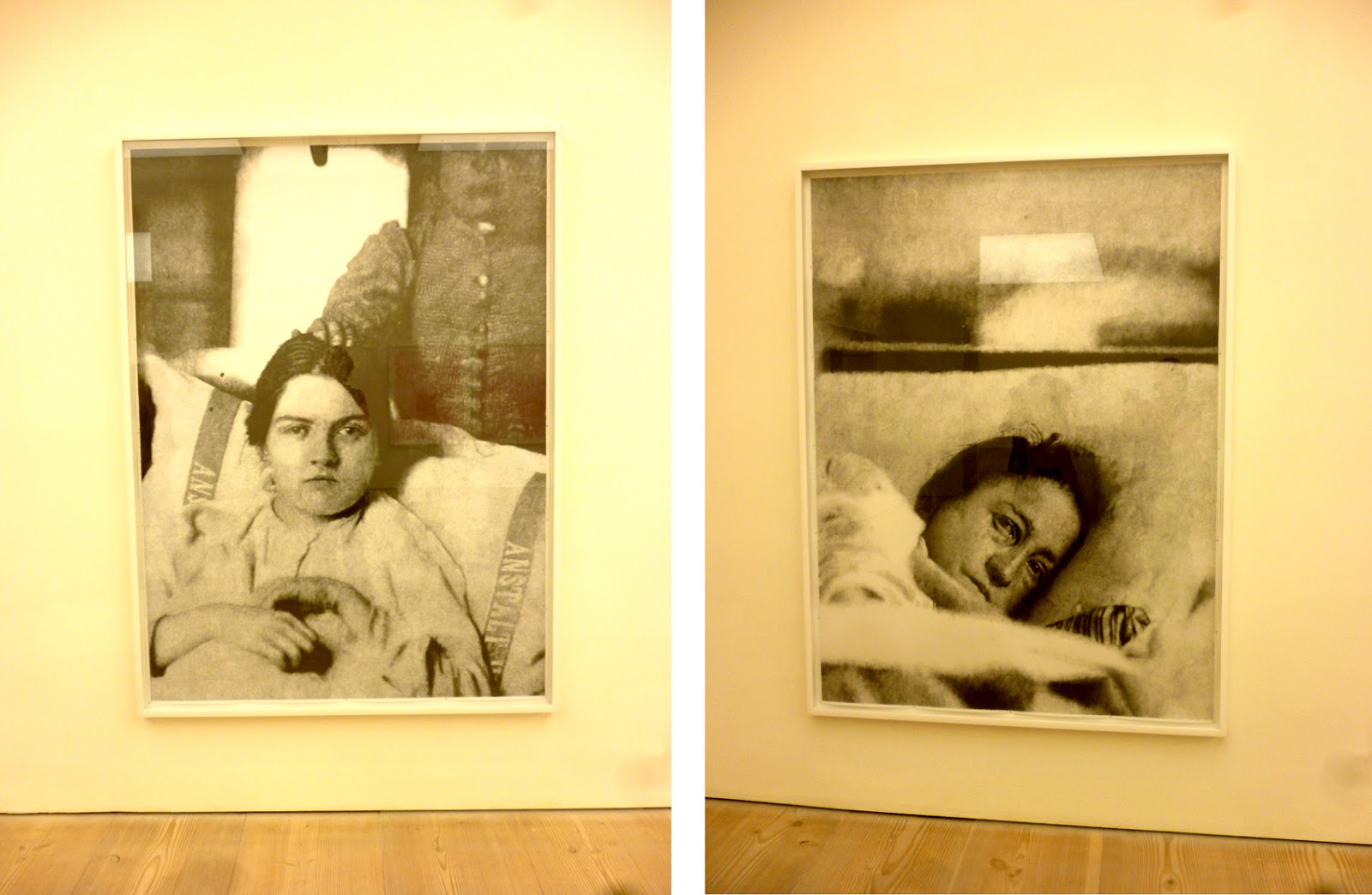
Two of a series of Portraits Cliniques by Eric Manigaud -- exquisite large-scale pencil drawings
Also at the Saatchi Gallery was a small survey of contemporary British art and a show sponsored by Hugo Boss which had an amazing interactive work. You projected your own shadow onto the wall and then falling (digital) marks that fell constantly down the wall filled in any little bowl-like spaces that your shadow made -- and you could throw the marks up in a shower as well. It was beautiful.
Me with falling 'net'

I had the best time in Selfridges with my daughter when we 'dared' to go onto the designer floor and actually look at the posh clothes. As I habitually look like an extra from Worzel Gummidge, it's a wonder we weren't thrown out, but I expect they thought I was some sort of minder for the beautiful model who was with me. We (well, she) had a treat of a fro-yo from the Pinkberry shop in the Food Hall. I got a free taster of the salt caramel flavour frozen yogurt which was mindblowing. Here's what she got:
just don't think about the price... very lovely the fro-yo was too, specially the chocolate muesli topping.
Finally we went to see What Maisie Knew at the Gate Cinema in Notting Hill Gate, which, it being a Tuesday night, was full of rather grumpy elderly people shouting out to other elderly people to be quiet during the adverts. The film was a very impactful interpretation of the Henry James novel (brilliant novel), set in contemporary New York, with Julianne Moore, Steve Coogan and gorgeous Alexander SkarsgÄrd. Onata Aprile is fantastic as Maisie, passed from adult to adult and constantly told that she is loved until the words ring almost completely hollow.
Onata Aprile as Maisie