Sunday, 2 February 2020

A virtual walk around Richmond (Yorkshire)

Although I haven't lived there for decades, I still have a very strong sense of coming from Richmond in Yorkshire. My family on my mother's side have lived there for at least two hundred years and, before that, they lived in and around the villages of Thoralby and West Burton near Aysgarth, in Wensleydale, up the dales from Richmond. The men seem to have been mostly shoemakers and stonemasons, with a few soldiers thrown in.
My favourite painting of Richmond, by John Aldridge, 1955
I'm currently preparing to do a course in memoir-writing at the Faber Academy in London in a few weeks' time. The tutor will be Julia Blackburn and she's the reason why I have paid to attend the course (being normally unwilling to part with money for such things -- my memorable weekend with Martin Parr was the last time I put my hand in my pocket for such a thing). I've loved Julia's books for years and really admire the way she combines original and fascinating subjects with personal material so beautifully.
I've read and loved all of these books by her. My favourite is The Three of Us, because I'm so interested in families. I want to write a family memoir myself and have been gathering source material for it for a long time. I'm hoping the course is going to galvanise me into choosing one of several directions that I can see it taking and then getting on and writing it.
     There's a great reading list for the course which I'm working my way through -- memoirs characterised by a variety of forms, including Jackie Kay's autobiographical poem, The Adoption Papers and Giles Waterfield's novel about his grandparents, The Long Afternoon. The course is structured around the reading list and, I think, will give us the chance to try out different forms for our own autobiographical writing. I'm really looking forward to it.
If only my first home had been the beautiful Gothic house in the centre of the photo but it was the tiny cottage squeezed in next door
As soon as you start thinking about your family and your past, the memories crowd in. My approach is to try to capture as many as I can, even if they're fragmentary. I have hundreds of notes already which I'm going to have to try to put into some sort of order. Many of my earliest memories are located in the tiny cottage above, the one with the deep porch. It belonged to my maternal grandmother and she rented it to my Mum and Dad when they were first married. Inside the rooms were pretty spacious and it didn't feel cramped. There was a back garden that you could also reach down an alley that started a bit further along the road.

The road, called Newbiggin, was cobbled, and my actual earliest memory is of setting off in a car along Newbiggin and, before we reached the end, the back door beside where I was sitting swinging open. I saw the cobbles rushing along beneath me through the opening. No back-seat seatbelts in those days but I didn't fall out.
Newbiggin was down in one of the older parts of Richmond, but when I was nine we moved up to Maison Dieu (pronounced in a no-nonsense Yorkshire way as 'Mason Dew' -- the name came from an old religious hospital that had been there long before). This was a homecoming for my Mum because she had grown up in the tall house at the far right of the postcard above. The postcard shows a view of Maison Dieu from the River Swale down below (and my junior school is in the bottom left corner too). Here's the view from up on the road itself:
My great-granny was very entrepreneurial and, having run a 'department store' called Mattison's Bazaar down in the market place, when WWII broke out and things weren't so good in retail, she bought the red-brick house and let out some of the many rooms to boarders.
     Now imagine that you're crossing the road from that house, at a slight angle to the right, where the pavement rises above the level of the road. You'll be at the front gate of my new home.
The house with the blue door and the white chair outside was now our house. I lived there very happily until I went to university. Ultimately, my Mum lived there on her own before she moved down south to live near me, at the very end of her life. The house was sold and became a Bed & Breakfast. In October 2019 it 'starred' in an episode of Four in a Bed on Channel 4, which gave me a very creepy opportunity to snoop around my own former home. It had been changed around inside: bedrooms had been converted into en suite bathrooms and everything faced in a different direction from before. It was very therapeutic for me to see inside again because it magically cured me of the sad nostalgia I used to have for it!
This picture (above) is looking down Maison Dieu from the top of the road. The red-brick house is on the right, but you can only see the tiniest bit of it; my old house is down on the left, again not really visible. The two white buildings with the little bed of shrubs in front of them were both shops when I was growing up. The smaller, cream building was Mrs Boddy's shop and my mother would constantly send me along there to get things for our tea -- we never planned ahead, it seemed! And both shops had copious stocks of sweeties. I swear I was hardly ever without a quarter of something in my pocket or a chocolate bar. We just didn't think about sugar being bad for us in those days.
This is the aerial view of Maison Dieu. You can see it coming to a point on the left, where it meets Darlington Road, and you can see the little patch of shrubs and work out where the two sweet shops were. You can also see B&B at 43 marked, which was my old house.
Above is the same pointed bit, from an old map. And I've overlaid them as well:
The little area round the corner from the two shops is known as Anchorage Hill, because in 1274 an Anchorite nun was shut up in an 'anchorhold' or cell next to a tiny chapel and remained there for the rest of her life (food and water could be passed to her through a 'squint' or narrow gap in the wall). There's no sign of her cell any more but the chapel building is still there. It was eventually converted into three tiny almshouses in 1618. On the old map above you can see it labelled as 'Bowes' Hospital'. The patron of the almshouses was Lady Eleanor Bowes.
This is the Hospital from one end (above) and this (below) is it from the other end:
It's right next to a garage and so there's a monstrous sign obliterating it. I'm not sure whether anyone still lives there -- I think they might do -- but in 1871 my four-times great grandmother, Jane Mattison was one of the three tenants.
Her husband Jonas, a stonemason, had died in 1855. In the previous census, in 1861, she was still living at home at the bottom of Richmond, in Bargate, with a granddaughter, also called Jane, living in, and a boarder to bring in a spot of rent. But at some point after that she moved up to the almshouses. She lived until 1879, probably in the same place. I think relatives of ours named Thwaites lived in two of the other houses on Anchorage Hill, so they probably kept an eye on her.
Incidentally, this portrait of Elizabeth I, by an unknown artist, was found in one of the almshouses and is now kept safe in Richmond Town Hall -- I wonder if it was in the one my great granny lived in?
If you're still with me on this virtual tour of Richmond, we're turning round again now and heading back towards the town centre.
This is the war memorial at the top of Frenchgate. The big beast of a house on the right is Oglethorpe House, for many years painted a lurid mustard yellow. My mother lived there when she was very little, with her mum and dad, but not for very long. When I was three I went to kindergarten there, which I loved, even though I always had terrible scabs on my knees from falling over on the gravel paths that were all we had to play on.
We can look down Frenchgate from the war memorial: my grandparents and aunts and uncles have lived in so many of the houses in this street!
We're continuing along Pottergate, past this special scented garden intended to appeal to blind people as well as the sighted. I always insisted on running along the wall of the garden when I was little and once, inevitably, fell off, into the rose bushes. I've still got the scar where a thorn just missed my eye.
You can see the red-brick end of a house, on the left. It's the start of a little row of three Victorian houses.
The second and third houses in the terrace share a porch. I'm not going to give anything away here but I stepped through one of the doors under that porch quite a few times when I was a teenager. Teenage kicks were had in the attic... that's all I'm saying (pretty innocent kicks, actually, but even so). Over the road is another gorgeous Gothic house which was converted into a 'cottage hospital' in 1899. It's now a funeral directors'. The road that opens up between the two houses is Quakers Lane, where my best friend lived in a lovely house, just where you can see the orange barriers and some workmen.
This was the bottom of their drive and she and I spent sooooo much time sitting on that bench, seeing who might be coming along.
I could go on and on, wandering around Richmond, to Billy Banks Woods, round the Castle Walk, up and down Lombards Wynd and into every nook and cranny, but I'll stop there. Even though I haven't lived there for over thirty years, I still feel as though I know every paving stone.

Sunday, 10 November 2019

Can I find my Irish ancestor Jane? -- short answer, no

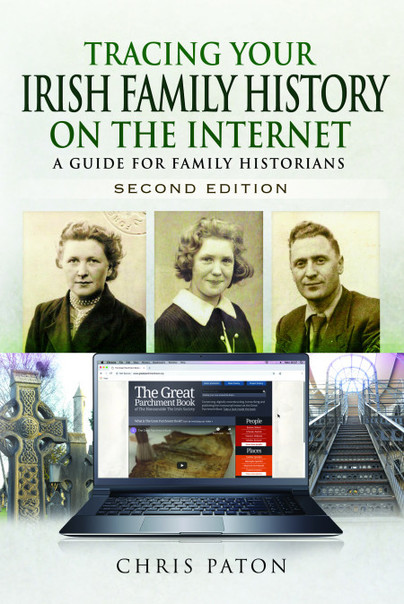
Image result for tracing your irish family history on the internet
Just out from Pen and Sword Family History -- could it solve my family history conundrum?

I was very kindly given a review copy of Tracing Your Irish Family History on the Internet by Chris Paton (Pen & Sword Books, £14.99). I decided to review it by using it to see if it could help me solve the biggest mysteries in my own family tree: what was my 4x great grandmother's maiden name and where did she come from? All I know is that she was also called Jane (like me) and came from Ireland.

This document was written by my great grandmother, Julia Mattison -- she was only a Mattison by marriage but she was very keen on the Mattison family history. We were a family very much rooted in Richmond, North Yorkshire, where I also grew up. Earlier generations of the family lived up Swaledale, at Thoralby. We were not wealthy by any means but we were artisans for the most part (or the men were): stonemasons, iron workers, shoemakers, upholsterers. Great granny Mattison ran Mattison's Bazaar, a department store in Richmond marketplace, and her husband John, who was a tinsmith, made pans and kettles and so on which were sold in the shop alongside 78rpm records, toys, china, pens, you name it. She also ran a lending library from the premises.
This photo shows four generations of our family: Great granny Mattison on the right (writer of the document above), her daughter (also called Julia) in the middle, my mother on the left and me aged three.
     Anyway, to get back to the question in hand, I only know about my 4x great grandmother Jane from my great granny's document. Jane was born on June 6 1794. I've established (from several census returns) that she came from Ireland, but I don't know where in Ireland or what her maiden name was.
This is an extract from the 1841 census, which records Jonas and Jane living on Castle Hill in Richmond (Yorks) with six of their children (in total I believe they had twelve children, although one or two died in infancy). The 'I' in the right-hand column of Jane's entry stands for Ireland as the place of her birth. Jonas was a stonemason. The date of Jane's birth according to this census would be 1801, which doesn't tally with the 1794 on our family document. I'm more inclined to believe the latter -- on census returns people often rounded their age up or down to the nearest 5 and it looks as though both Jonas and Jane may have done that in this instance.
Jonas and Jane lived in this cottage on Castle Hill. According to the census, eight people were living here in 1841, half of them adults.
     To cut a very long story short, that's pretty much all I know about Irish Jane. Without her maiden name it's nigh on impossible to find her in Ireland. Chris Paton's book is an excellent resource which lists a vast number of Irish genealogy resources along with pointers on how best to use them, but no resources in the world can find an unknown 'Jane'. On Ancestry, I managed to draw down a list of 'Janes' born in Ireland at the end of the eighteenth century but, without other clues, it's impossible to know whether any of them is my Jane. There's no record (that I've found) of Jonas and Jane's marriage either in the UK or Ireland (UK more likely, I think, as Jane probably emigrated to England or Scotland as a young woman) and perhaps they never formalised their relationship. Who knows?
     Sometimes you just have to let these things go. Perhaps one day someone else on Ancestry will pin Jane down and I'll be able to borrow their findings. For now, I'm going to leave well alone.

Sunday, 30 June 2019

Away BACK To Lamorna


A beautiful aquatint of Lamorna Cove by Geoffrey Sneyd Garnier (Penlee Museum & Gallery, Penzance)
We've just come back from a week in Cornwall and there's a little bit of a story to why we stayed where we did. It only seems like a couple of years since we were last there, but I see from my blogpost about it that it was April 2012! That first time, we stayed in the second house from the left in the terrace (above), but we saw that the next-door house was much nicer than the one we were in. Through the large bay windows we couldn't help but notice beautiful paintings on the walls, stacks of lovely china in the alcoves and attractive furniture. In fact we even found ourselves at an auction on the same day as next-door's tenants (at David Lay in Penzance -- very good) and later we saw all their beautiful purchases laid out in their window (this made a strong impression on me as success at an auction is something I value highly). It turned out to be possible to rent that next-door house for holidays and so this time it was us in the beautiful house, which we now know is called Cove House.
Cove House (on the left with two bay windows and extension)
In the comments book, someone had described the house as 'Kettles Yard by the sea' and it certainly has that flavour. There's enough modern stuff to enable life to be lived more or less as normal (hot water, big cooker, small TV and so on) but otherwise one feels one has passed through a membrane into the past.
I liked the old flags used as curtains in the bathroom and the stacks of chunky Portmerion mugs with Bewick prints on them in the kitchen.
There was a wonderful lamp with prints clipped to the shade -- too frail to use but splendid to look at:
Dora makes a determined stand for modernity
My favourite object in the house was this strange little figure:
There was a brand name on the back, or perhaps it was even a marketing slogan, but I forgot to make a note of it. If anyone knows anything about her mysterious ballbearing anatomy, please leave me a comment about it.
     The best thing about Cove House is really its location, right down by the sea in front of the little harbour (and, necessary evil, the car park) at Lamorna Cove. You can have your feet in the sea in half a minute, or you can be sitting in the little enclosed garden in even less time. The sea performed a full repertoire for us, from emerald calm to silvery seething to foamy waves -- always mesmerising.

The whole of the Cove is privately owned and changed hands recently, causing some anxiety. Parking is very strictly overseen, although a parking place comes with the house booking (plus another one in the tiny garage, if you should happen to drive a miniature car). I have very fond memories of having the crab and fish soup at the cafe decades ago when I spent two Christmases in St Ives with my mum -- they still serve the soup but the bowl of it that I had this week wasn't the splendid rich concoction of memory (and some reviewers on TripAdvisor seem to agree with me). But times change. As do I -- against my better judgment, here are a couple of photos of me from the first time I went to Cornwall, in the mid-Eighties. Note the legwarmers...

On one of the front windows of Cove House is a little notice, part of the advertising of it as a holiday rental:
This intrigued me greatly. I adore Arnold Bennett's Potteries novels and it was exciting to think that we were staying in a house he once stayed in -- although having tried to psych myself up to a pitch of 'resonance' with AB, I decided in the end that it's impossible to get a real sense of a person's presence from being in a place they once were. Still, he probably slept in the same bedroom and looked out at the very same view. I decided, as soon as I got home, to try to research his visit (or perhaps visits) in more detail. Stop here if you don't want to wade into a long episode of sleuthing...
     In the postcard on the window (above), which is dated 1908, Cove House is not actually there. To begin with there were only three houses in the terrace -- Cove House was built later. You can see that the building materials are a little different in the earlier photo of the house exterior. And the little extension was built later still. This is borne out by comparing this map, from the decade of 1900-1910...
The three houses in the terrace are just to the left of the footbridge. Although there's hard-standing for another house, there isn't actually a building there
...with this one from the 1960s:
Cove House has now been built and is named on the map
Alas, I haven't found a map for the decades in between so can't pinpoint exactly when the house was built. It was probably between about 1910 and 1920, I think.
     Here's an old photo of Cove House before the garage extension was built:

Now here's a postcard from the Sixties, with the garage now added:
The whole cove had been developed by this stage, with a car park, sea wall and slipway. The cafe has been created on the left as well. But I think that Cove House was perhaps also run as a tea room in the 1930s.
     In her biography of Arnold Bennett of 1974, Margaret Drabble says that Bennett came down to Cornwall for a six-week stay in July and August 1930, right at the end of his life (he would die of typhoid from drinking tap water in Paris the following March). He came with his partner, the actress Dorothy Cheston -- they don't seem to have brought their four-year-old daughter Virginia with them. He had just finished his last (full) novel, Imperial Palace, an epic contemporary story built around the running of the Savoy Hotel. Bennett was a celebrity and there was interest in where he had chosen to spend his holiday:
Birmingham Daily Gazette, 18 August 1930
Shortly after Bennett's death, this letter appeared in the Staffordshire Sentinel (27 April 1931):
It's this letter that makes me think that Cove House functioned as a tea room -- the 'unpretentious little cottage, one of a row, facing the water'. As a publisher myself, it's exciting to imagine Bennett sitting in our holiday cottage correcting his proofs!
     Although Imperial Palace was Bennett's last completed novel, when he returned to London in September (following a short cruise on a friend's yacht), he began another novel, Dream of Destiny, which he would not finish. In this, he has a character declare:
And in a letter from Cornwall to his nephew Richard, Bennett wrote, 'On the whole, this is certainly the best English holiday I have ever had, and one of the very cheapest.' He went on:

Later in the holiday, at the end of July 1930, the couple moved up to Trewoofe (pronounced 'Trove'), a comfortable house at the top of the lane that leads down to Lamorna Cove, owned by the Shaws. Their daughter was the excellent painter Dod Procter.
     Bennett's final verdict on his Cornwall staycation (which, as far as I know, was his only visit to the county) comes in a further letter to his nephew:
And I agree with every word of that.
'Green Sea, Lamorna Cove' by Dame Laura Knight -- the sea was even greener than this during our stay

The green sea, and Porthmeor Beach, seen through the window of one of the studios in the St Ives School of Painting, last week
If you'd like to stay in Cove House yourself, you'll find all the details here: http://www.lamornacovehouse.com/ (btw, none of the above is intended to 'advertise' the house, it's just written out of my interest in a lovely place!)

Friday, 12 October 2018

Vera Lynn: One of the boys?

Vera Lynn, the Forces' Sweetheart
I've been listening to Vera Lynn songs to get into the mood of the 1940s which is the setting for the novel I'm writing -- 1946 to be precise. It's sung at a talent competition in 1940 by a character whose funeral opens the narrative. It struck me that the four words of the song's title had an intriguing ambiguity (is it an instruction or a question?) which could be applied to the book's narrator, Jean. Jean goes through a great deal of intense emotional upheaval and distress in the course of the novel but is at pains to hide her emotions -- in particular, not to cry. In a sense, the deeper business of the book is to explore why that is. What has happened to her in the past that has, to a degree, locked up her heart?

When I was fully into the writing, though, and really trying to get in touch with the period, I decided I must hear the song I'd named the book after. "Don't You Ever Cry" is fairly obscure as Vera Lynn's recordings go, but I was able to buy it on a double CD, Sincerely Yours, Vera Lynn. The song turned out to be wonderful, with a fabulous big-band arrangement (from Ambrose and his Orchestra) and in fact the whole album was an absolute revelation to me. Previously I had not really known Dame Vera's music, although she recorded many glorious belters that I know anyway, such as "Jealousy", the gorgeously passionate 1925 song by Jacob Gade with its tango rhythm -- this is the song that my Granny would always be banging out on the piano when I arrived at her house with my Mum and Dad and a package of fish and chips on almost every Saturday lunchtime of my whole childhood. You could hear her crashing through the chords and singing at the top of her voice before we even opened the front door of her small house in Darlington.
     I'd always thought that Vera Lynn's music would be rather stiff and clipped but I actually love her versions of the great standards. Her recording of "A Nightingale sang in Berkeley Square" is perfect: clear, innocent but beautifully lilting -- you believe absolutely that she has fallen in love on a romantic Mayfair evening. And her rendition of the Inkspots' classic, "If I Didn't Care" is the best version of all those I've been able to find online. I even prefer it to the original. Vera adds just the right amount of yearning to lines such as '"Why do I lie awake all night and dream all day long?" -- I love the way her voice falls away on the long drawn-out 'lie'.
     The upshot of this new love affair with Vera's music has been that I've listened obsessively to my favourite tracks as I've driven to and from work over the last few weeks and I've now learned a short 'set' of songs which I belt out as I wait in the nightly jam on the motorway (Oh lord, shades of Granny!). I've tried to perfect all of Vera's diction and the places where she 'swerves' the notes a little (oh yes, she does, you know!). My set consists of "Don't You Ever Cry",
"If I Didn't Care", "A Nightingale sang in Berkeley Square" and "When You Wish Upon A Star" in which I also have to sing the male part of Vera's duet with Jack Cooper. I'm not going to lie, now that I've got these four songs off pat I've started to indulge in a highly seductive fantasy where my novel is being launched at some ritzy venue and I come sashaying in in a long frock and perform the book's 'title song' into an old-fashioned microphone. Don't worry, it's only a fantasy -- I know my limitations.
As I listened over and over again to all the songs on my CD, something occurred to me that also had a bearing on my novel: Vera doesn't exclusively sing lyrics from a woman's point of view. Sometimes there's a degree of ambiguity, where it could be a woman or a man expressing their feelings and sometimes she definitely sing's a man's part. Take "I'll Be With You In Apple Blossom Time", for instance:

“I’ll be with you in apple blossom time,
 I’ll be with you to change your name to mine.
 One day in May I’ll come and say,
 'Happy the bride the sun shines on today'.

 What a wonderful wedding there will be,
 What a wonderful day for you and me.
 Church bells will chime,
 You will be mine
 In apple blossom time”

There can be no doubt that the 'voice' of the lyrics is a man when he says he'll change his betrothed's name to his. 

And in "Don't You Ever Cry", the 'voice' of the song is clearly a soldier who has gone to war and who tells the girl he has left behind not to worry about him:


 "Don't you ever cry, don't ever shed a tear.   Don't you ever cry after I'm gone.  Promise me you'll smile, darling, all the while  We'll be back together later on.
  Don't you ever cry, don't ever worry, dear,  Soon each care will be a memory.  Tears are all in vain, we will love and laugh again  So don't you ever cry for me." 

Vera Lynn is and was so profoundly identified with the War effort that she was a highly effective propaganda weapon. Her radio broadcasts held the battered nation together and were a familiar voice from home for British troops overseas. Her lyrics repeat over and over again the longing for the war to be over, looking forward to the time when 'love and laughter' will start up again. She kept us going in a very real sense, I believe.
     I find it interesting that the role she plays in her songs' narratives could be relatively fluid and she could sing both to and as men and women. My gut feeling is that this may have been made more possible by the fact that she was a relatively plain, straightforward person who didn't go to great lengths to appear glamorous and ultra feminine. When Vera toured Burma to visit British troops in 1944, at no small risk to herself, the men were thrilled to see and meet her and treated her like a kind sister in whom they could confide their fears and hopes. She said they behaved towards her with great respect.

I've become more tuned in to fluidity between male and female roles since writing my novel. In it, the three main characters all find their gender identities under pressure for different reasons: in particular the two men's masculinity is undermined, one because of his sexual activity and the other because he can't conform to the rather rigid norms of masculinity expected by mid-twentieth-century British society for health reasons. Meanwhile Jean, the narrator, is forced to take on a role more usually played by men. It was very interesting to write. 
    [Added later: After living with my novel for a while and polishing it to the shine of a nice teak sideboard, I decided to change the title to a line from another of Vera's songs that I've learnt. It's taken from "If I Didn't Care" and it's "If This Isn't Love" so that's my title as of now. I think it speaks of the book's themes very nicely. Now I want to find an agent who absolutely loves my novel and who will represent it with passion so, special lovely agent, please make my dream come true.]
[Added later still: in August 2024. I can't believe so much time has passed since I wrote this post. If you've read this far you deserve an update: I have managed to find representation, with a fantastic literary agent, Laura Macdougall at United Artists. But, but, but, this novel into which I've poured so much energy over the last few years, is not destined to see the light of day (or not for the foreseeable, let's say). It's the wrong story or the wrong time for that particular story, so I move on to fill new pages. I'll paste this note at the end of all my posts about this book.]